02 · The workflow layer
Habitat
The workflow layer for an AI-first team. One surface where your engineers and your agents do the same work, planned, built, verified, and shipped against one source of truth, not the five tools that lose the thread.
- Layer
- Workflow, the middle of the stack
- Built on
- Canon, one shared corpus
- Spans
- Discovery to production
- Status
- Ships with the engagement
The problem it removes
The spec, the work, and the proof, in five different tools.
The plan is in a spreadsheet. The requirement is in a doc. The tickets are in a tracker. The conversation is in chat. The evidence is in a folder, if it was kept at all. Each tool is fine on its own. What breaks is the thread between them: the line from a decision, to the work that delivered it, to the proof it shipped snaps at every handoff. Jira-shaped tooling fragments the job, and agents inherit that fracture hardest. When a person or an agent picks up a task, half the context is already somewhere else.
See it work
Watch one ticket carry its whole record, spec to ship.
Live preview
Why it's different
One surface for people and agents alike.
Habitat reads from Canon. A work item starts from the PRD, the decisions, and the standards already settled in the corpus, so the spec is not retyped and the context is not re-gathered, whether a person or an agent picks it up.
That is the part a tracker cannot copy. Assign a ticket to an Olympus agent and its run lands on the same board a person's would, grounded in the same Canon context and returned through the same verification gate. The bench files in here too: Peril routes feedback into a ticket, Ally files an accessibility finding. One surface, so every loop closes in the same place.
What it does
Run the work, prove it, keep the record straight.
- 01
Plan & build
Runs the work you already run
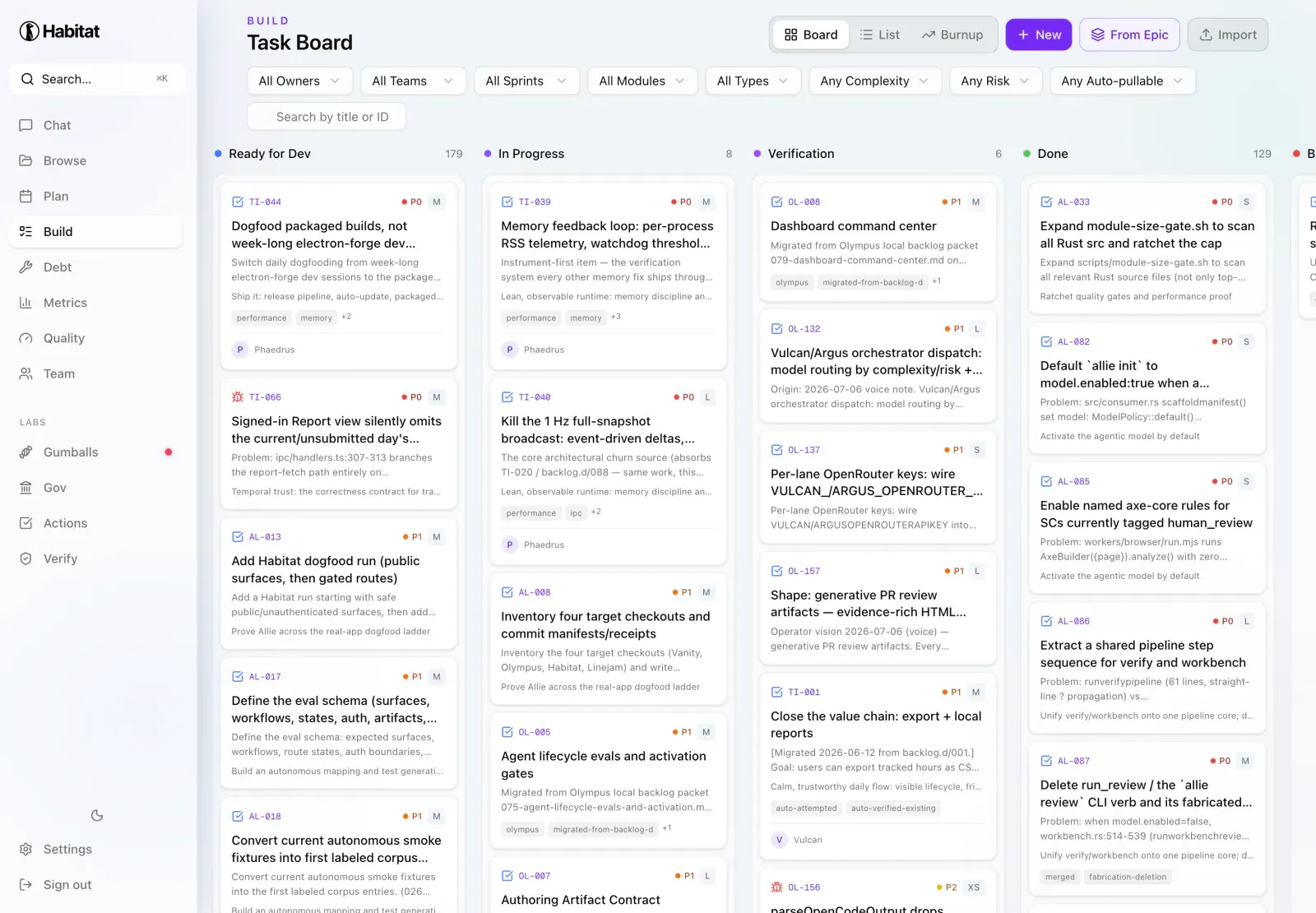
Roadmap, cycles, sprints, and real capacity per person. Then every task, bug, epic, and PRD on a single board, moving ready → in progress → verification → done. Each change in state is kept, so a work item's history is never reconstructed from memory.
- 02
Verify
Won't let it ship unproven
A verification gate drawn from the PRD itself. Each item carries its evidence, a test, a doc, a demo, a sign-off, before the work can close. Configure it to block the merge outright, or to flag the gap and let it pass. It is the same gate an agent's run has to clear.
- 03
Operate
Keeps the delivery record straight
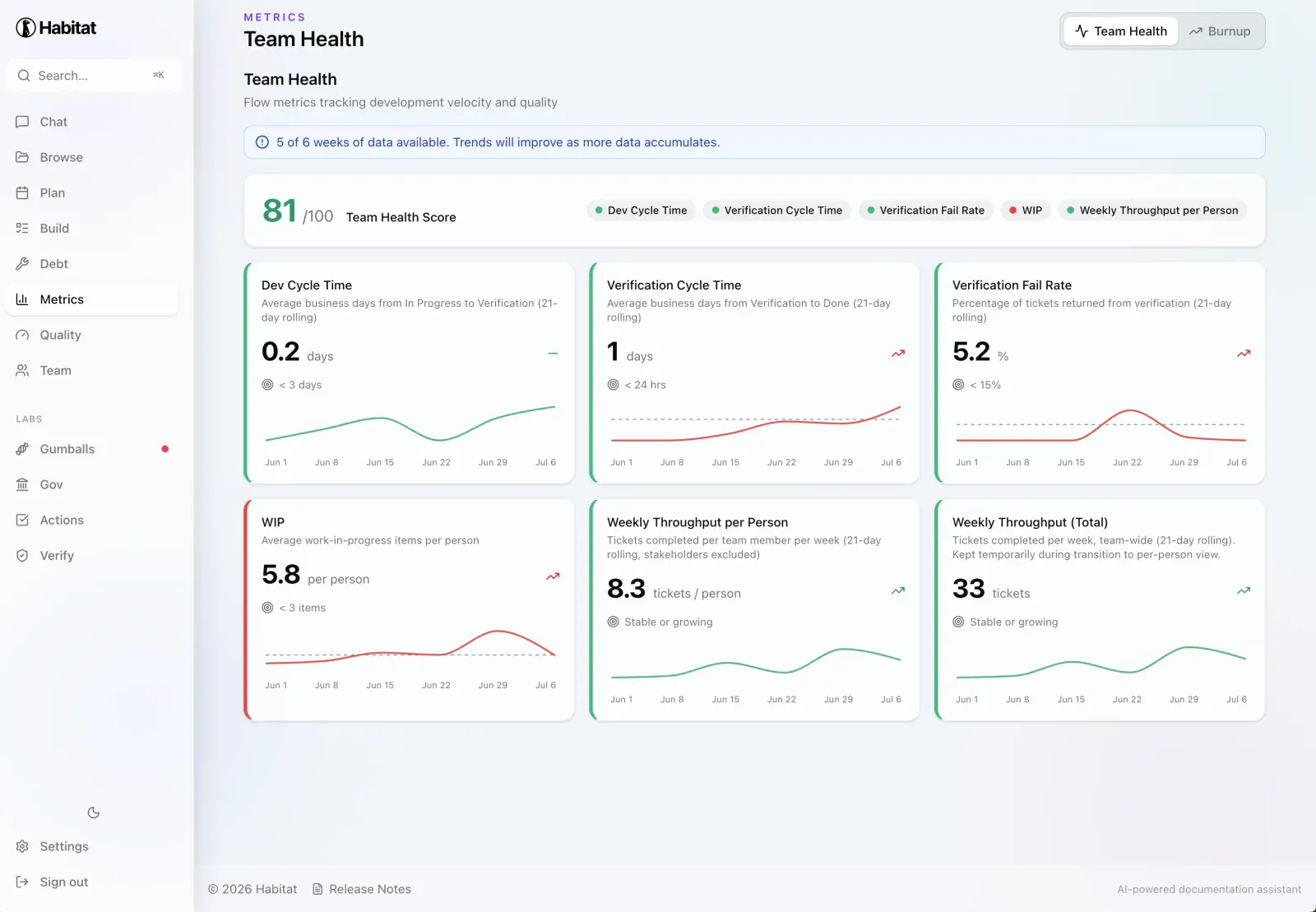
Intentional debt, weekly priorities, the burn-up, and live metrics sit next to the work, not in a separate wiki. It is the operating picture of a release at a glance, legible to a new hire or an auditor. The durable decisions and specs live one layer down, in Canon.
A closer look
The board, and the record it keeps.
How it's organized
The layer, mapped.
Plan
Roadmap · cycles · sprints · capacity · PRDs
Build
Work board · epics and tasks · status history
Verify
Checklists · evidence · the sign-off gate
Operate
Governance · debt ledger · priorities · metrics
See it run your own workflow.
Thirty minutes with the people who build it: a working walkthrough and straight answers.
It ships with the engagement, tuned to your stack. The source is yours to keep. No per-seat metering.